

Meeting customers where they are when it comes to health needs
Humana Future of Personalized Insurance
Project Overview
Humana positions itself not only as an insurer, but also customers’ lifelong health partner. To help Humana explore potential service concepts, we reimagined future service offerings that will drive new customers to Humana while improving the existing experience. Over the span of 6 months, we conducted extensive research and co-designed with our research participants 2 projects.
Our goal for the Personalized Insurance project is to discover customers’ values and needs around healthcare services and customize these insurance plans from a service and cost perspective to serve individuals and families in the way customers desire. Our approach is letting customers play a role in designing their own insurance plans, showing our dedication in making insurance truly about them, and eventually changing their attitude towards Humana to a trusting one.
Team Structure and Responsibility
2 designers, 2 senior strategists, 4 researchers, 1 product manager
I worked on analyzing research data, turning it into service ideas with strategists, and creating mockups and prototypes to deliver these service concepts and strategies to the client. Our researchers surveyed across 560 insurance customers and worked closely with 15 of them to discover sentiments and opinions towards insurance plans across a number of different companies.
I helped mediate some interview sessions and synthesize the findings, both qualitative and quantitative, to develop an accurate understanding of customer pain points. Then, I collaborated with the strategists to distill the research insight into actionable concepts and ideas that we can implement, and eventually created the visual assets to present these ideas to the client.
Survey Results
We surveyed 560 people, with a 25-minute online survey to get a broad view of attitudes, behaviors, and preferences. Then we conducted co-design session with 15 participants to learn about their health and insurance needs.
We found out that our participants are very stressed: 73% feel stressed about work, 60% about physical and mental health, 47% family caring, 33% lack of support and life stage event. Though 100% our of participants downloaded health-related apps, only 60% spoke about using health-related apps. Their health support network stays within close family members and few healthcare professionals, and is relatively small. We also noticed a common theme of holistic health (including diet, growing vegetable gardens, homeopathic and alternative medicine) points to value areas where their insurer could offer support, coverage and greater options; COVID still remains a significant concern top of our participants’ minds.
In terms of engagement and relationship with insurers, 61% can recall what type of plan they have, and 39% can recall what their monthly premium is without looking it up. 85% indicating they are satisfied with their insurance, but 39% also said are often frustrated with their insurer. Also worth noting is that 55% think of their insurer as a transaction or a safety net, which validates our concerns and the direction we’re moving towards.
Therefore, we realized that digital experiences need to adapt to diverse contexts and meet customers where they are to serve individuals’ changing needs.
Co-Design Plan
When members imagine a deep relationship with their health insurer, this unlocks a series of service opportunities that addresses unmet needs. Humana is well placed to meet these needs, and through the co-design exercises, we aim to find out the most desired service concepts that will create the longitudinal value and reimagine the digital-first commercial customer relationships.
We collaborated with 15 participants, with 5 hours of one-on-one virtual sessions. Based on the survey results, researchers and strategists came up with 13 service ideas, which we tested with various levels of fidelity with our participants and narrowed down to 5 key concepts. During these sessions, we learned a great deal about each participant, about their personal and professional lives, their attitude and approach to health and wellness, as well as their frustrations and expectations about better health management.
Customer Value Framework
Our participants ranked the top 5 areas that matter to them the most when it comes to the overall care for their wellbeing:
Preventative Care: take care of myself to prevent health issues
Family & Friends: take care of people I love and their health
Ongoing Care: manage an ongoing health issue
Mental Health: practice self-care to maintain my mental health
Acute Care: deal with acute health issues successfully
Co-Design Insights:
Through our Co-Design interviews, we discovered 4 main insights from our participants:
Managing health is not top of mind for customers
People feel healthy and are not thinking about health all the time, even for those who are actively managing health issues. Health may not be the first point of entry.
Opportunity areas:
Build a relationship first.
Life stages present opportunities to support decision making.
Awareness + health status offer service opportunities.
People are stuck in the paradigm of insurer as ‘intel inside’
Health insurance is a double-edged sword – you must have it, but it’s just not offering value. People do not have a relationship with insurers. Expectations are low that an insurer could offer more, and stakes are high because of the cost.
Opportunity areas:
Help people to reimagine their care.
Reframe the narrative around what an insurer can do.
People need support, and they are very open to you providing it
People have all kinds of demands for health support, and insurers are expected to do more.
Opportunity areas:
Consider different mindsets towards engaging with insurer.
Create supportive relationships by offering immediate benefit and longer-term value.
The consumerization of healthcare is in effect
Gen Z’s active consumer mindset, plus physicians are changing their services towards consumerization and adopting digital best practices, so insurance should keep up with current expectations
Opportunity areas:
Rise to meet the evolving expectations for digital health.
Address the shifting needs of 21st Century families.
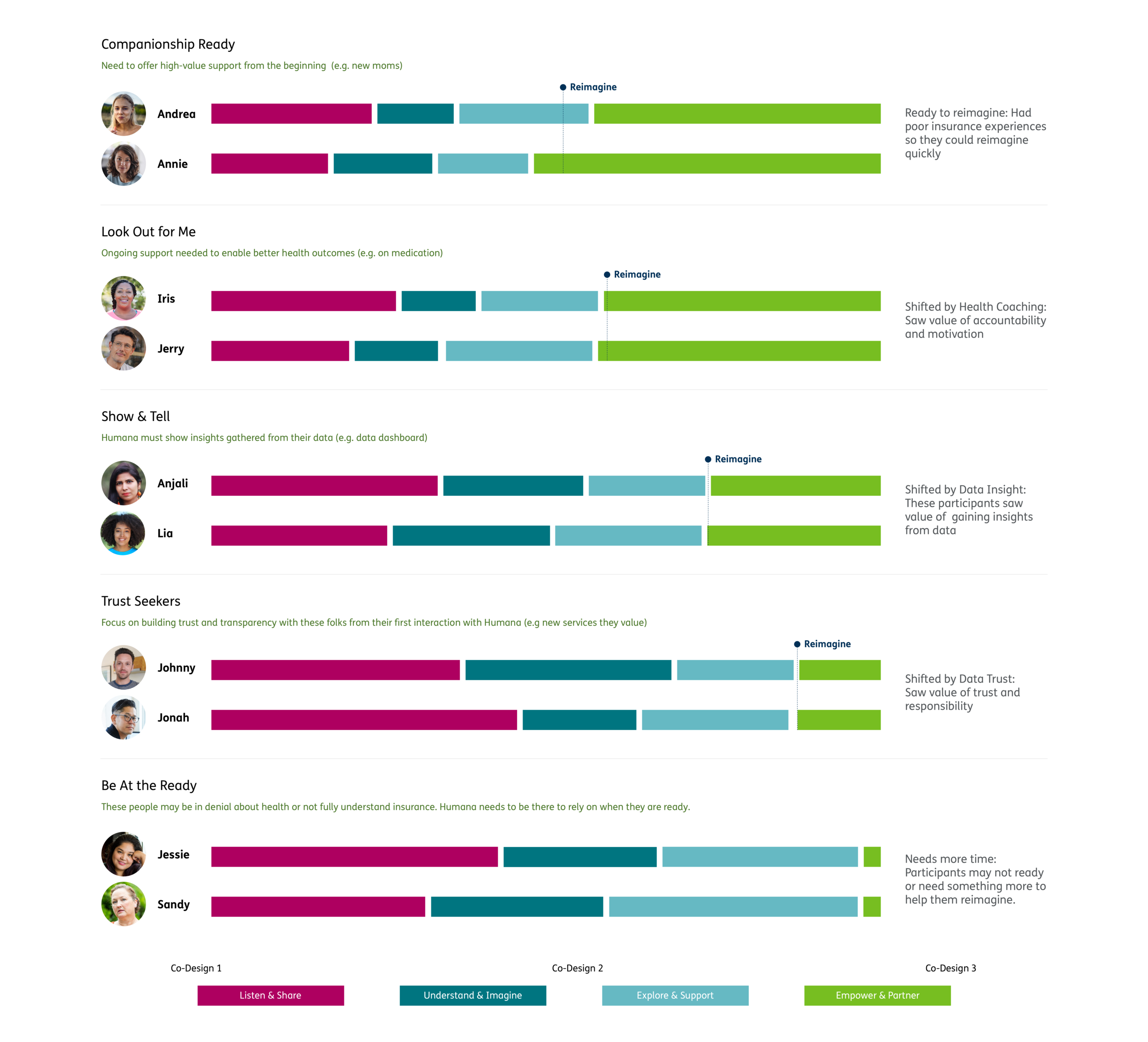
5 Patterns Observed on Reimagining Relationship
During the 6 weeks that our Co-Design sessions took place, we observed these patterns in our participants in reimagining their relationship with an insurer. Although participants showed different levels of understanding and comfort when it came to reimagining a new kind of insurance plan, with sufficient support, most participants feel comfortable shifting away from the current insurance models.
Co-Design Service Ideas
Through the 3 stages of the Co-Design process, we were able to define themes from our conversations with the participants which we turned into service ideas. These ideas were then prioritized by the participants based on which ones were of most valued to them.
We mocked up 5 top ranked service ideas out of 13, and finalized the top 3 after Co-Design 3. They represented the most desired services, validated through the customer value framework, and service prioritization process:
Provider Matching Tool
Preventative Care Support
Build My Plan
1) Provider Matching Tool
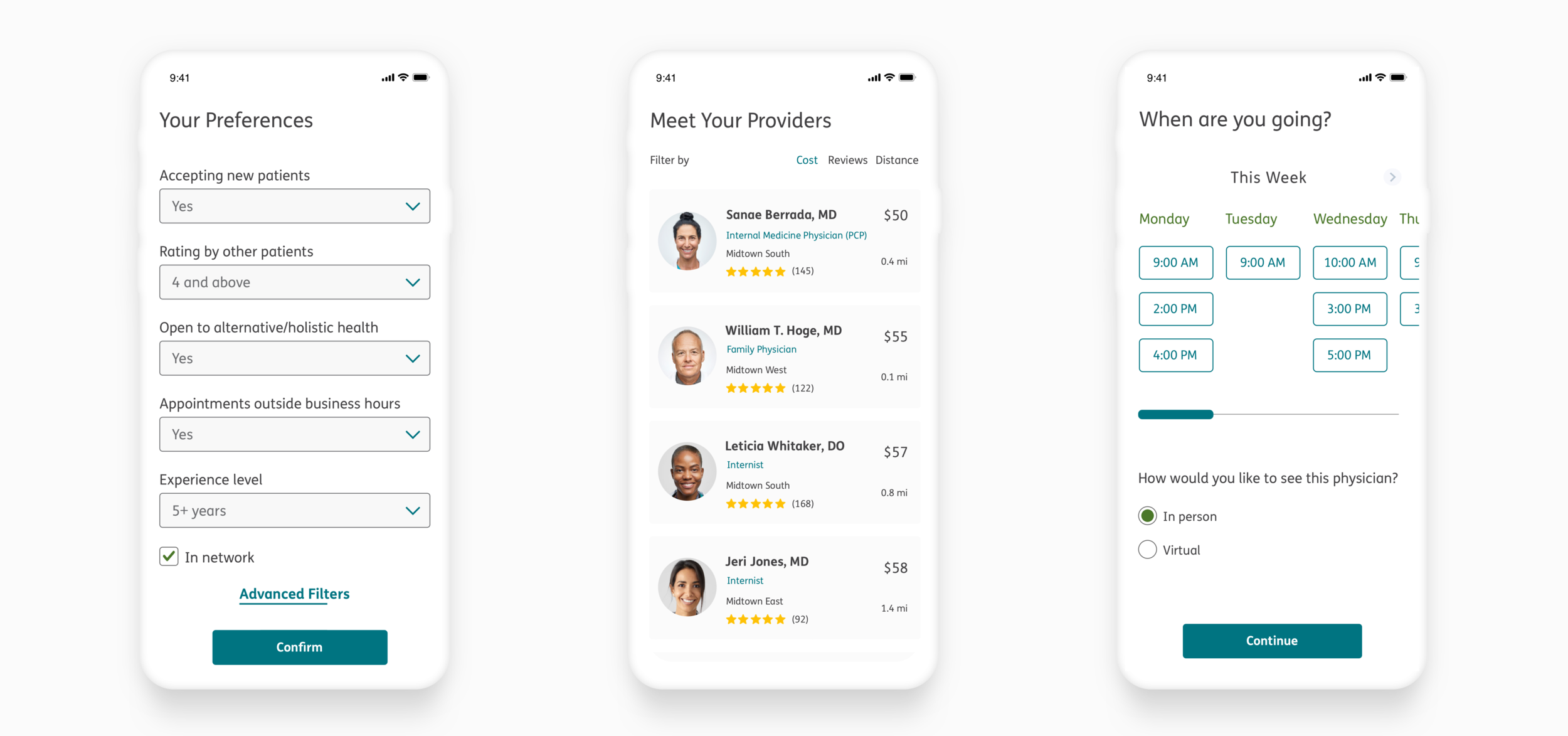
We allow customers to search for physicians, specialists, and therapists that fit their preferences. These preferences can be saved and pre-populated based on previous engagement or settings to demonstrate Humana’s personalization aspect. These criteria return a list of providers displaying name, photo, specialization, cost, distance, ratings, location.
We connect to appointment API for real time availability and appointment booking. Our participants are very cost conscious, so we offer the ability to see estimated cost of visit, % of deductible spent, and average costs of common procedure under same plan. We also provide reviews from prior patients for social proof, which was very popular among our participants.
User Needs & Design Considerations
Users want to have fact-based logistical information and subjective assessments of providers’ personalities to find the right provider
Solution: Search experience allowing users to filter and sort by most relevant criteria
Users want better understanding of insurance coverage and cost
Solution: Provide personalized upfront cost based on user’s plan coverage
Users want all provider information in one place
Solution: Rich provider profile pages including cost transparency, location, personalization, ratings, reviews and appointment booking in one place
Users want an insurer who knows them
Solution: Personalization based on user data

What does this achieve?
The Provider Matching Tool empowers customers to find a a provider and easily connect to their data and other services in one place. Customers can see personalized data that provides relevant information or actions to facilitate their journey and decision making. Also, upfront costs and coverage under their current plan also become very transparent.
2) Preventative Care Support
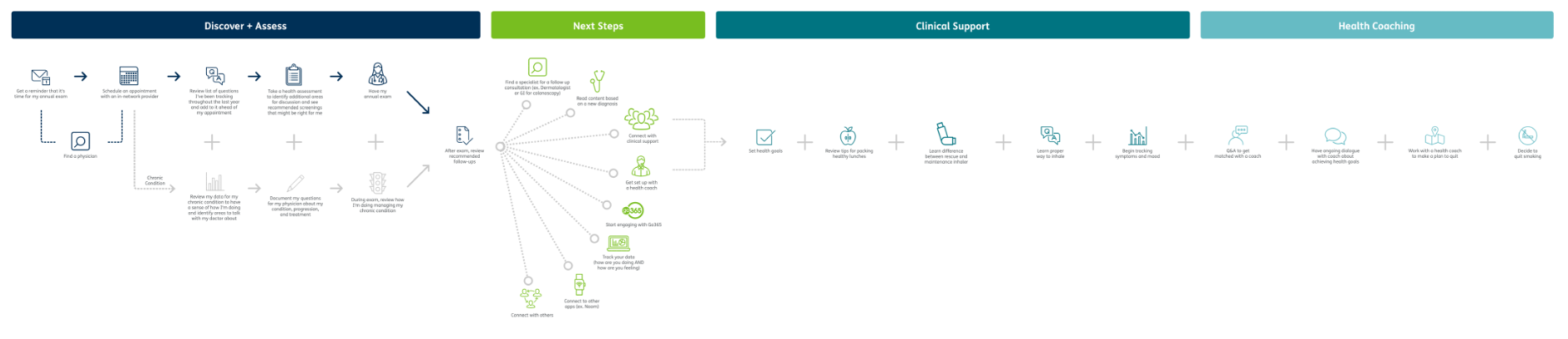
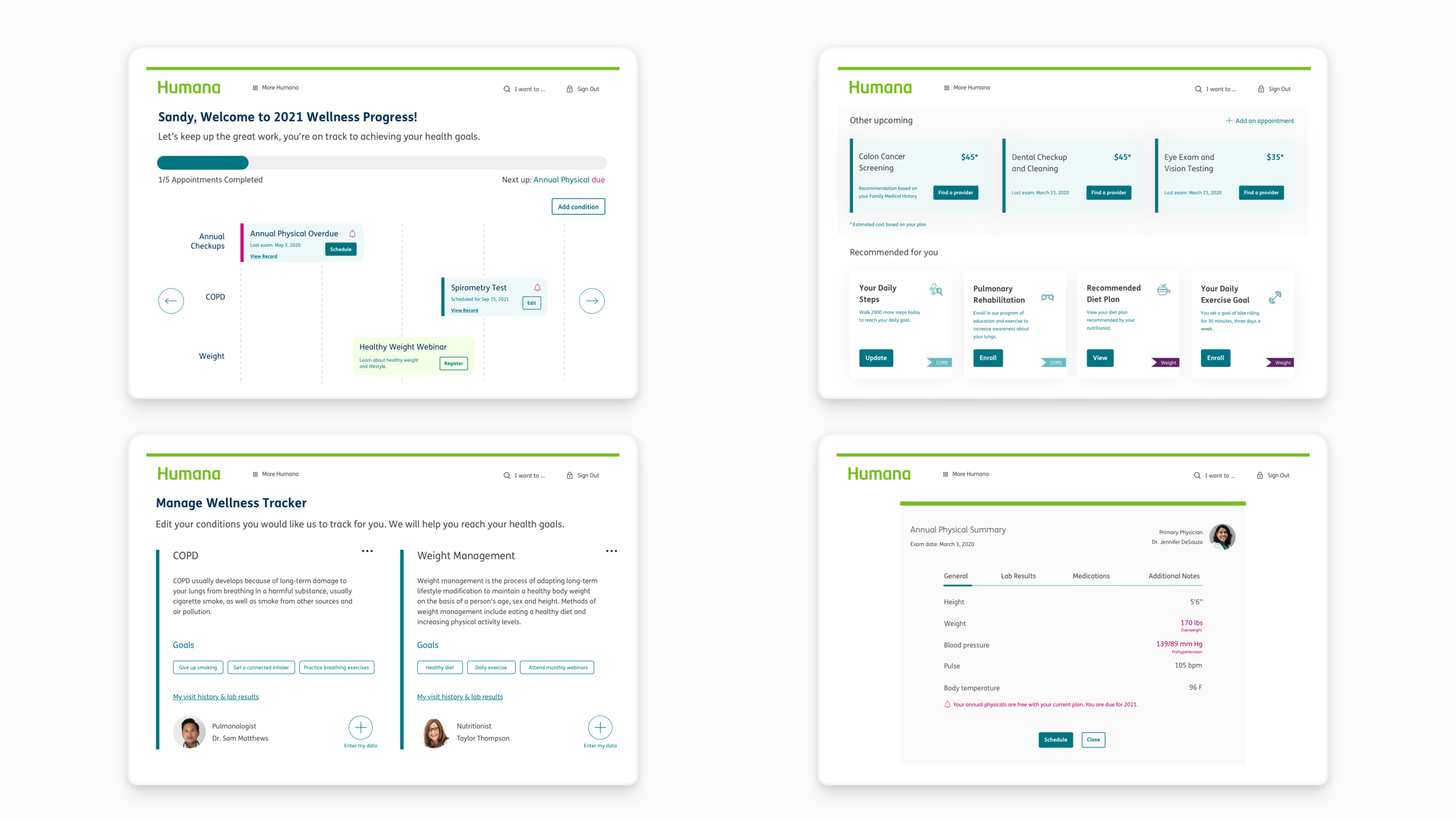
The Preventative Care Support presents an overview of preventative care activities and progress in timeline view. Activities are personalized based on user profile (age/gender), clinical information, and engagement. On the dashboard, customers can manually add issues or conditions to their preventative care plan. Their dedicated are team will then add personalized content recommendations to help support user in their journey.
User Needs & Design Considerations
Users all have a unique set of preventative care needs depending on various factors including age, gender, life events, medical history, etc.
Solution: Provide personalized and comprehensive overview of users’ unique preventative care plan and how they can take action
Users do not accurately perceive the severity of their chronic conditions and don’t take preventative care to manage/minimize chronic conditions
Solution: Ability to expand preventative care to chronic condition management, offering tools, resources, actions
Users tend to be reactive in seeking health care. User struggle to get motivation and want ways to have more accountability over their health and preventative care
Solutions: 1) Proactively send notifications and reminders. Recommended actions should be made easy and accessible 2) Integrate support features like chat or health coaching to help pace, goal set, motivate and provide on-going support
Users are interested in support/resources beyond medical care i.e. mental health, holistic care, wellness
Solution: Offer tools, resources, based on user engagement, need and interest i.e. wellness and alternative medicine
Users don’t mind sharing data if there is value, but sensitive to sharing certain data types
Solution: Allow users to opt-in for areas with data sensitivity
What does this achieve?
The Preventative Care Support concept enables customers to get proactive reminders and clear actions to take control of their health. Customers can see personalized plan and resources that support their specific wellness needs. They also have a clear overview of their preventative care needs, understand the value, and see clearly defined actions to control their health.
3) Build My Plan
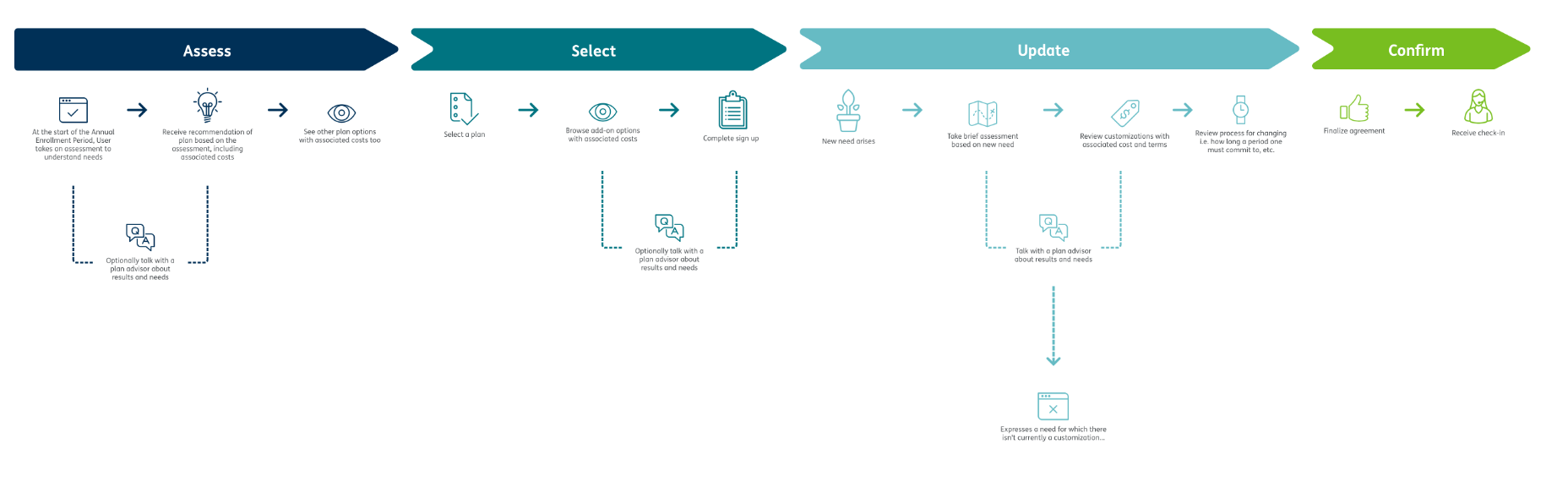
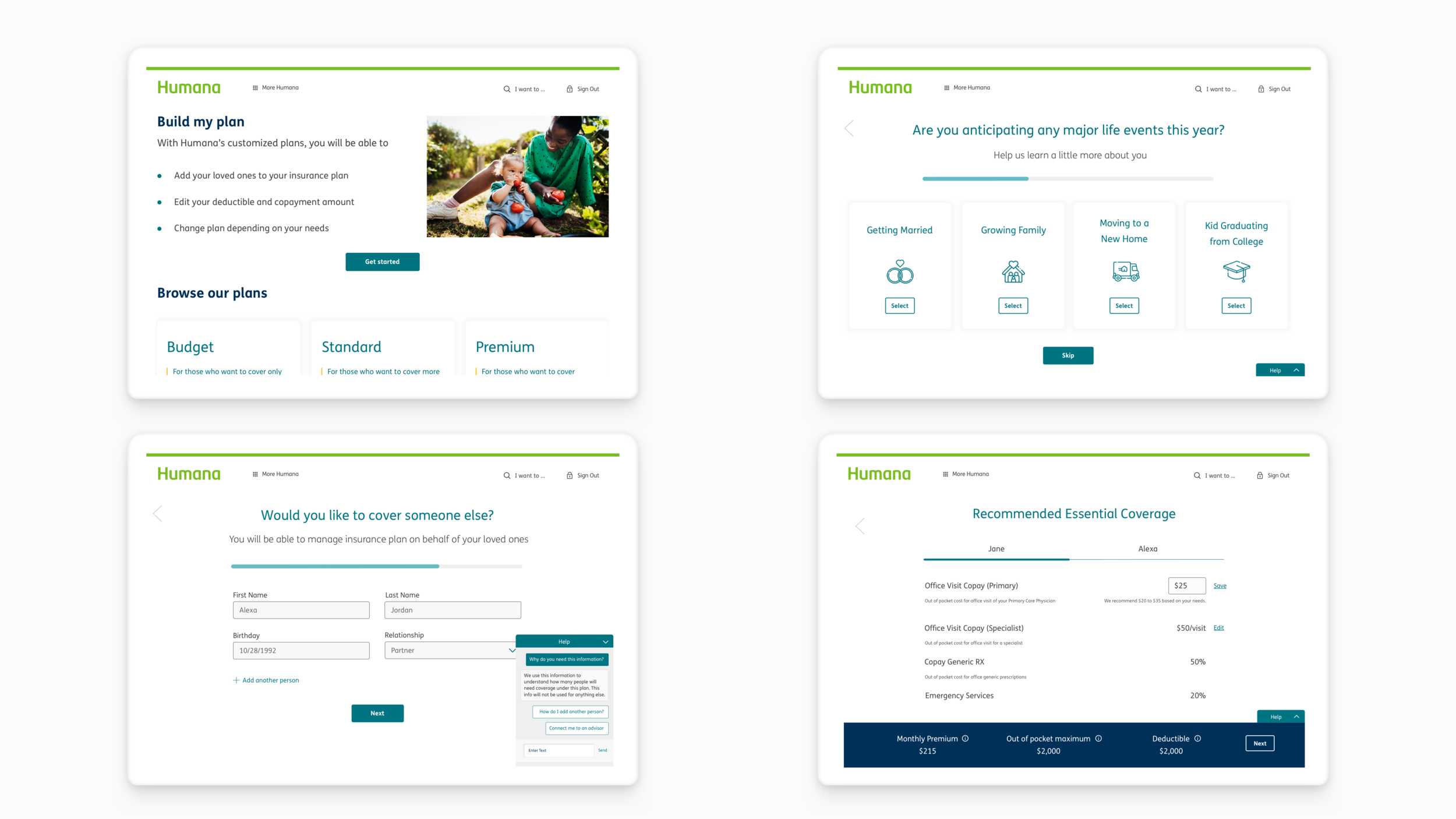
With Build My Plan, customers can see progress bar so they know where they are in the process and anticipate how long it will take. The brand new customers and those who have previously had coverage will enter the enrolling flow. Returning customers will have data pre-populated for easy usage. Customers enter basic information to profile for essential coverage recommendations. Data points like gender, age marital status (pre-populated and new) will be used to inform recommendations.
We provide data policy disclosure to give customers the peace of mind about data security. We allow the ability to add dependents to their plan that matching their unique family structures and select areas they may require extra coverage.
Based on data provided in previous steps, customers see recommended plan for essential coverage and extra offerings. All fields provide guidance copy to help user understand complex terminology. As user edit offerings within their plan, the monthly premium, out of pocket maximum and deductibles will update in real time to reflect any changes made.
User Needs & Design Considerations
Insurance plans are difficult to understand
Solution: Use language users can understand and provide educational component and real time support
Users lack awareness to what their plan covers and what benefits are available to them
Solution: Clearly outline coverage, added benefits and cost to user
Users want better understanding of cost and only pay for what they need
Solution: Allow user to clearly see cost associated with coverage and give users control over what they pay
Users have changing needs that traditional plan structures may not cover
Solution: Provide modular coverage options based on user need i.e. new family structures, mental health support
Users have many life events (beyond qualifying life events) that can impact health engagement
Solution: Allow for flexibility to update plan beyond qualifying life events
What does this achieve?
The Build My Plan concept provides flexible models that allow users to choose exactly what coverage they get and how much they pay and can update as needed. They have clear understanding of coverage and cost, and they feel confident and secure about the plan they have selected, knowing that they/loved ones are taken care of. Customers now also take control of their plan structure and cost, depending on their specific needs at the time.